






















Most theatrical stages are equipped with flood lights to “flood” large areas with wide-angle beams, but how about a real flood—the kind where water rushes onto dry land?
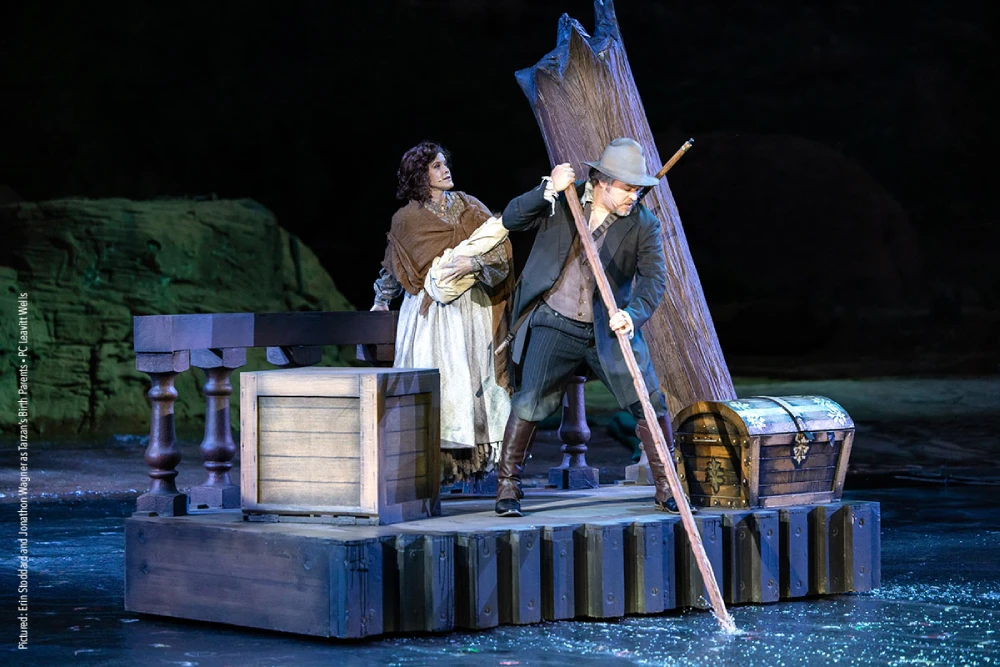
This kind of flood is one of Tuacahn’s most popular special effects, and if you’ve been to see Tarzan this year, you’ll have experienced the dramatic show opening, featuring a heart-stopping shipwreck and subsequent torrent of water gushing down the red rock mountains and flooding the stage. It’s just one of those details that brings the story to life and adds magic to the Tuacahn experience.
But how do they do it?
 Flooding the stage isn’t a new trick for Tuacahn—they’ve been pulling it off since the very beginning with the production of Utah! in 1995—but the process has evolved over the years, especially with the hiring of Matthew Monge as Special FX and Pyrotechnics Supervisor.
Now in his second season, Monge has been busy overhauling and automating the whole process. This has required an immense amount of work, including digging trenches and putting in over 22,000 feet of cable. No longer does someone have to crouch up on the hillside with a radio to know when to release the water—now it can all happen remotely via a phone or tablet!
But where does the water come from? This is a desert, after all.
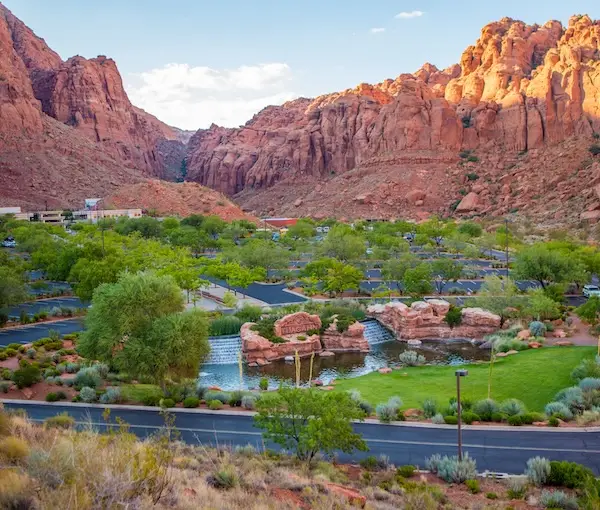
The answer is a recycled water system that starts with a large pond tucked away off to the right behind the stage. It’s known as “Lower Pond,” and it holds 300,000 gallons of water, which is about 15 times a typical swimming pool. Next to Lower Pond, an underground cement bunker holds two powerful pumps which pull water at the astonishing rate of 2,000 gallons per minute per pump up the mountain to a separate pond holding area. This is “Upper Pond,” which can hold about 40,000 gallons of water.
Once Upper Pond is full, the water spills over a metal gate, flowing through a riverway and down a series of waterfalls to a third pond, called the “Plunge Pool.” When that’s full, it courses over another waterfall into one more pond, called the “Texas Pond,” which got its name during the original production of Utah!
 “To get ready for a show, I need the Upper Pond filled, I need the Plunge Pool filled, and I need the Texas Pond filled,” Monge explains, as he demonstrates how he figured out that if he got the water levels up to the right level before the flood, then the water from the Upper Pond would literally skip across the surface of the ponds, so that it could submerge the stage in record time.
Monge’s eyes light up as he describes the process. It’s obvious he loves his job. “When the Stage Manager gives the ‘GO’ to send the flood,” he says, “we drop the upper gate as fast as we can. The gate lowers and 40,000 gallons of water makes its way down, swelling the riverbed and waterfalls, skipping across the plunge pool, down another waterfall, over the surface of the Texas pond, and BAM, that massive amount of water hits our stage. We have a couple of sandbags on the side to guide it in, and then it floods the stage anywhere from 2-4 inches deep, depending on how much we send. It takes about 8-10 seconds.”
It may come as a surprise that they stop the flow before Upper Pond is empty, but the key to having such a forceful wave is having the weight of 40,000 gallons of water behind it. Monge explains, “We tend to close the upper gate a little bit to slow the flow, so it’s easier to stop. So, when the raft from Tarzan goes across, it’s starting to settle. By the time they’re off and the gorillas bring in their mats, it’s pretty much done. Otherwise, it would just keep coming. We could flood the stage for 10 minutes, no problem.”
It’s one thing to release a deluge down a mountain and control its flow onto a stage, but where does it all go?


Although it’s not always obvious to the audience, the water’s journey doesn’t end at the stage. It spills off the rounded edge of the stage and into the “baffle,” which is a big, black open-sided box that rims the front of the stage. The water disappears through grates in the floor and into a hidden passageway below. Then it drains into a pipe which extends 200 feet, straight back to the original Lower Pond.
“Everything always ultimately goes back to the pond. It is a closed system, with very little water loss, except what is evaporated during the day,” adds Monge.
Pulling off this level of special effects requires a great deal of planning and work, but when its done right, the results are worth the effort. Don’t miss your chance to see the flooding of the stage in action at Tuacahn’s production of Tarzan, showing through Oct. 21. For tickets and showtimes check out www.tuacahn.org or call 435-652-3300.
